Blog

You’ve been thinking about this project for a while. Maybe it’s the deck you keep putting off, or the custom home you’ve finally decided to stop dreaming about and actually build. Whatever it is, you’ve reached the part where you have to hand some of that vision over to someone else — and that’s where things get complicated. Pagosa Springs isn’t a big city. Word gets around. And for anyone who’s spent time here, you’ve probably heard at least one story about a contractor who disappeared mid-project, or delivered something that looked nothing like what was agreed on. Those stories exist because people didn’t know what to look for before they signed anything. This guide is about helping you avoid becoming one of those stories. Knowing how to choose a contractor in Pagosa Springs — the right way, with your eyes open — is the single most important step before any ground gets broken. What Actually Matters When Vetting a Contractor There’s a short list of things that separate a legitimate contractor from someone who’s just good at talking. None of this is complicated, but it’s easy to skip when someone gives you a confident handshake and a reasonable-sounding number. License and registration . Colorado requires general contractors to register with the state. This isn’t just a formality — it means someone has verified that this person meets a baseline of professional standards. Ask for their license number and look it up through the Colorado Department of Regulatory Agencies. If they can’t produce one or get cagey about it, that’s your answer. Insurance — both kinds. General liability and workers’ compensation. The first covers damage to your property during the build. The second protects you if someone gets hurt on your land and the contractor has no coverage. Don’t take their word for it. Ask for a certificate of insurance and make sure it’s current. This is the part people skip because it feels awkward. Don’t skip it. References from real, similar projects. Not names on a list — actual conversations. Call the people. Ask them what went wrong, not just what went right. Every project hits a snag somewhere. What you’re trying to find out is whether this contractor communicated honestly when things got hard, or went quiet and hoped you wouldn’t notice. A written contract that actually covers things. Scope of work, timeline, payment schedule, materials, and change order process. If a contractor hesitates to put details in writing, they’re protecting themselves — not you. A clear contract is a sign of someone who runs a serious operation and expects to be held to it. The Red Flags That Are Easy to Rationalize (Don’t) When you like someone or their bid comes in lower than the others, it’s tempting to talk yourself out of the things that feel off. Here’s what should stop you cold, no matter how much you want to move forward: ● A large upfront payment demand. Asking for 10–15% up front is normal. Asking for 40–50% before any work begins is a warning that something isn’t right. ● No physical presence in the area. A P.O. box isn’t an office. A contractor with no real local address has very little accountability if things go sideways. ● Pressure to skip permits. This is never them doing you a favor. Unpermitted work creates legal liability, tanked property values, and headaches when you go to sell. Anyone who suggests skipping them is looking out for their timeline, not your home. ● A bid that’s dramatically lower than the rest. Sometimes it means they missed something. Sometimes it means they plan to cut corners. Either way, ask them to walk you through how they arrived at the number. ● Slow or vague communication from the start. If they’re hard to reach before you’ve given them any money, imagine what it’ll be like once they have it. Questions Worth Asking Before You Hire Anyone Your first meeting with a contractor is an interview. Go in with questions and pay attention to how they handle them — confidence, clarity, and honesty under simple questions tell you a lot about how they’ll behave when a problem comes up mid-project. ● How long have you been working in Pagosa Springs or Southwest Colorado, and can I see examples? ● Who will physically be on my site every day — you, a crew lead, or subcontractors I haven’t met? ● Walk me through what happens when something unexpected adds to the cost. Who decides, and how does that get communicated? ● Are you pulling permits, and who handles the inspections? ● What’s the most common cause of delays on projects like this, and how do you handle it when that happens? The answers matter less than how they answer. Someone who’s done this long enough will be comfortable with every one of these questions. Someone who isn’t will let you know. Local Contractors vs. Out-of-Town Contractors: The Honest Difference It’s not that contractors from outside Pagosa Springs can’t do good work. Some can. But there’s a practical reality that doesn’t get talked about enough: when something goes wrong after the job is done — and at some point, something always needs attention — a contractor who drove four hours to get here is a much harder person to get back. There’s also the matter of local knowledge. Building in Southwest Colorado has its own set of challenges — elevation, freeze-thaw cycles, specific county permit requirements, material sourcing, and seasonal access. A contractor who’s been working this region for years has already solved problems that would catch someone from the Front Range off guard. When you find a general contractor in Colorado who actually lives and works in this community, you’re not just hiring their skills — you’re hiring their stake in the outcome. Their next client is probably someone who knows you. That’s not a small thing in a town this size. Why Whispering Pines Has Earned the Trust of This Community Whispering Pines didn’t build its reputation by being the loudest company in the room. It built it the slower way — project by project, conversation by conversation, by showing up when they said they would and doing what they said they’d do. Serving Pagosa Springs, Chama, and Durango, they handle a wide range of construction work: custom homes, steel buildings, deck construction, commercial builds, and garage door repair and installation. What holds all of it together isn’t the breadth of services — it’s the consistency. Every client gets honest pricing, clear communication, and a team that treats the project like it belongs to someone who matters. One thing worth mentioning specifically: Whispering Pines offers lifetime decks. That’s not a marketing phrase — it’s a statement of confidence in their materials and their methods. You don’t make that kind of commitment unless you’re genuinely certain about the quality of your work. If you’ve been working through a contractor checklist and wondering who actually checks every box, this is worth a conversation. Start with the Right Decision Every project starts long before the first tool comes out. It starts with the conversation you have before any of that — the one where you figure out if you can trust the person standing in front of you with something you care about. Knowing how to choose a contractor in Pagosa Springs means knowing what to verify, what to ask, and what to walk away from. It means choosing someone who is genuinely invested in this place, not just passing through it for a paycheck. Whispering Pines is ready to have that conversation with you. Call (970) 398-4308 , or reach out online for a free quote. Whether it’s a garage door, a steel structure, or the custom home you’ve been planning for years, they’re the team Southwest Colorado keeps coming back to. Frequently Asked Questions 1. Do general contractors in Colorado need to be licensed? Yes. General contractors in Colorado must register with the state, and specialty trades like electrical and plumbing require their own additional licensing. You can verify any contractor through the Colorado Department of Regulatory Agencies before you sign a single thing. 2. How many bids should I get? Three is the standard recommendation, and it’s a good one. Not because you should automatically go with the middle number, but because having three bids gives you enough context to ask the right questions. If one comes in dramatically lower, you need to understand why before you decide anything. 3. What should a contractor checklist actually include? At minimum: proof of license, current insurance certificates, references from comparable projects, a detailed written contract, a clear payment schedule, confirmation of who handles permits, and a realistic project timeline. If a contractor can’t address all of these clearly and comfortably, keep looking. 4. Is hiring local really that different? In a place like Pagosa Springs, yes. Local contractors know the climate, the terrain, the permit requirements, and they have a community reputation to protect. They’re also the ones who can actually come back if something needs attention after the project closes out. That accountability is hard to put a price on. 5. What’s the most common mistake people make when hiring a contractor? Letting a good first impression or a low number override the red flags. A confident personality and a compelling bid are not the same as a proven track record. Do the homework — check the license, call the references, read the contract — before any money changes hands.

Hey—if your garage door has started making that sound again… you know the one. Not loud enough to panic, but enough to make you pause for a second before hitting the button. Most people don’t think about their garage door until it starts interrupting their routine. A delayed open when you’re already late. A strange tilt that wasn’t there last winter. You tell yourself it just needs “one more repair.” But there’s a point where fixing stops fixing anything. And knowing when to replace the garage door becomes less about cost—and more about control. Let’s walk through the signs you might already be noticing, but haven’t fully trusted yet… Sign 1: You’re Calling for Repairs More Often Than Feels Normal It never feels like a big deal at first. A spring break—you fix it. The door gets noisy—you lubricate it. Something misaligns—you adjust it. But then it happens again. And again. You start noticing a pattern: ● One issue gets fixed, another shows up weeks later ● Service visits feel routine instead of rare ● You’re mentally budgeting for “the next fix” That’s the shift most people miss. A garage door isn’t meant to need constant attention. When it does, the system is wearing down as a whole—not failing in isolated parts. This is where the garage door replacement vs repair question becomes real. Because at some point, you’re not repairing damage. You’re maintaining a slow breakdown. Sign 2: The Door Doesn’t Sit Right Anymore Stand outside your garage and just look at it for a second. Not quickly—actually look. Does it sit evenly? Or does one side dip slightly lower? Do the panels look straight, or do they feel… tired? Sagging isn’t just visual. It changes how the entire system carries weight. ● Tracks take uneven pressure ● Hinges compensate in ways they shouldn’t ● The opener works harder than it was designed to You might not notice it every day. But your door does. Every time it moves. And once structure starts shifting, small fixes don’t restore balance—they just delay the inevitable. Sign 3: Your Home Feels Harder to Heat or Cool This one surprises people. You don’t usually connect your garage door to your energy bill. But if your garage is attached to your home, it quietly affects everything. Older doors leak air. Not dramatically—but consistently. ● Cold air slips in during winter ● Heat builds up during the summer ● Insulation breaks down without you seeing it And your HVAC system keeps compensating. If your home never quite feels stable temperature-wise, your garage door might be part of that story. Upgrading to a new garage door in Pagosa Springs with proper insulation doesn’t just improve the garage—it stabilizes the space next to it too. Sometimes the issue isn’t inside your house. It’s what’s attached to it. Sign 4: You’ve Started Questioning Its Safety This is usually a quiet thought, not a loud one. You press the button… and watch it a little more closely than before. Maybe it hesitates. Maybe it closes harder than it used to. Maybe the sound has changed—and you can’t quite explain how. That hesitation you feel? It matters. Garage doors are heavy systems under tension. When parts wear out, they don’t always fail gradually—they fail suddenly. Watch for subtle warnings: ● A slight delay before movement ● Jerky or uneven closing ● Sounds that feel sharper, tighter If your trust in the door has changed, that’s not overthinking. That’s awareness. And no repair fully restores confidence once it’s gone. Sign 5: It’s Been There Longer Than You Realize Time sneaks up on garage doors. You stop noticing how old it is because it’s always just… been there. But materials fatigue. Technology ages. Performance drops quietly. If your door is pushing 15–20 years or more, it’s not just about whether it still works. It’s about how well it works compared to what’s available now. ● Older doors lack modern safety systems ● Insulation is often minimal or nonexistent ● Wear builds up in places you can’t see If you’re already dealing with even one or two of the signs above, age amplifies them. And suddenly the question isn’t “Can I fix this?” It becomes “Why am I still trying to?” The Real Difference: Repair Buys Time. Replacement Gives Relief Repairs keep things going. Replacement changes how it feels to use your garage every day. No hesitation. No second-guessing. No mental note to “deal with it later.” That’s the difference most people don’t expect—but immediately notice. So… What Should You Do Next? If you’ve read this and recognized even two of these signs, you’re already closer to the answer than you think. You don’t need to wait for a full breakdown to act. In fact, that’s usually when the situation becomes more stressful—and more expensive. At Whispering Pines , the focus isn’t just on installing doors. It’s on helping you decide clearly—without pressure—whether repair still makes sense or if it’s time to move on. If you’ve been wondering when to replace the garage door, this is where uncertainty turns into a decision you feel good about. FAQs 1. How many repairs are too many before replacing? If you’ve had multiple issues within a year, especially across different parts, it’s usually more cost-effective to replace than continue patching problems. 2. Is a sagging garage door dangerous or just cosmetic? It’s structural. Sagging affects weight distribution, which increases strain on components and raises the risk of sudden failure. 3. Can a new garage door really impact energy bills? Yes. Insulated doors reduce air transfer, helping stabilize indoor temperatures and lowering HVAC workload over time. 4. What’s the average lifespan of a garage door? Most doors last 15–30 years depending on material, usage cycles, and maintenance quality. 5. How do I decide between garage door replacement vs repair? Look at patterns, not single issues. Frequent repairs, structural changes, or safety concerns usually indicate replacement is the better long-term option.

Construction decisions directly affect long-term financial performance. Many property owners now prioritize cost-efficient structures that deliver durability without compromising functionality. At Whispering Pines Company, discussions often begin with how Affordable Steel Building Contractors can balance upfront investment with long-term returns. The appeal lies not just in pricing, but in strategic design, efficiency, and lifecycle savings. Selecting the right contractor shapes the entire project outcome. Affordable Steel Building Contractors focus on optimizing materials, reducing waste, and improving build timelines. These combined factors create measurable financial advantages, making steel construction a practical solution for those seeking higher returns on investment. Cost-Efficient Material Utilization Steel construction allows precise material planning, which significantly reduces waste during the building process. Contractors calculate exact quantities needed, minimizing excess materials and lowering overall project costs. This level of efficiency contributes directly to improved return on investment. A Steel Storage Building Builder in Pagosa Springs, Colorado often uses pre-engineered components to streamline construction. These components are manufactured with accuracy, ensuring consistent quality while reducing on-site labor requirements. Efficient material use supports both cost savings and structural reliability. Faster Construction Timelines Time is a critical factor in construction-related investments. Shorter build timelines allow property owners to begin using their facilities sooner, accelerating revenue generation. Steel structures are typically faster to assemble due to prefabricated components. When working with Steel Building Contractors Near Me, projects often progress more efficiently because materials arrive ready for installation. Reduced construction time lowers labor costs and minimizes delays, contributing to a quicker return on investment. Long-Term Durability and Low Maintenance Steel buildings are known for their strength and resistance to environmental factors. Unlike traditional materials, steel does not warp, crack, or deteriorate as quickly. This durability reduces maintenance costs over time. Steel Building Manufacturers Near Me often design structures to withstand extreme conditions, including heavy loads and changing weather patterns. Lower maintenance requirements mean fewer repairs and reduced operational expenses, which directly improves long-term ROI. Energy Efficiency and Operational Savings Modern steel buildings can be designed with advanced insulation systems that improve energy efficiency. Proper insulation helps regulate indoor temperatures, reducing heating and cooling costs. A Steel Storage Building Builder in Pagosa Springs, Colorado may incorporate energy-efficient panels and reflective roofing materials. These features lower energy consumption, creating ongoing savings that enhance the financial performance of the property. Flexible Design for Multiple Uses Steel structures offer design flexibility that supports various applications, from storage facilities to commercial spaces. This adaptability allows property owners to modify or expand buildings as needs evolve. Working with Steel Building Contractors Near Me ensures that structures can be customized to meet specific operational requirements. Flexible design reduces the need for future reconstruction, preserving investment value over time. Reduced Labor and Construction Costs Labor expenses represent a significant portion of construction budgets. Steel buildings require fewer workers and less time for assembly, which lowers overall labor costs. Steel Building Manufacturers Near Me often produce components that fit together efficiently, reducing the need for extensive on-site adjustments. This streamlined process minimizes labor intensity and contributes to overall cost savings. Higher Resale and Asset Value Properties constructed with steel often maintain higher resale value due to their durability and modern design. Buyers recognize the long-term benefits of low maintenance and structural reliability. Affordable Steel Building Contractors design buildings that meet evolving market demands. This forward-thinking approach ensures that the property remains valuable, making it easier to sell or lease in the future. Conclusion Strategic construction decisions can significantly influence financial outcomes. At Whispering Pines Company, many clients choose Affordable Steel Building Contractors because they offer a balance between cost efficiency and long-term performance. By working with Affordable Steel Building Contractors, property owners can reduce expenses, improve durability, and maximize the overall return on investment. Call Us Now! Looking to invest in a cost-efficient and durable steel structure? Contact Whispering Pines Company today at (970) 398-4308 to explore construction solutions designed to maximize value, reduce long-term costs, and deliver reliable performance for your property investment. FAQs 1. How do Affordable Steel Building Contractors improve ROI? Affordable Steel Building Contractors improve ROI by reducing construction time, minimizing material waste, and lowering maintenance costs. Their efficient building methods ensure that projects are completed faster while maintaining structural durability and long-term performance. 2. Are Steel Building Contractors Near Me a good option for small projects? Steel Building Contractors Near Me can handle projects of various sizes, including small-scale structures. Their ability to use prefabricated components makes them efficient for smaller builds while still delivering strong and reliable construction results. 3. Why choose Steel Building Manufacturers Near Me for construction? Steel Building Manufacturers Near Me provide high-quality materials that are designed for durability and precision. Their products reduce construction time and maintenance needs, making them a practical choice for long-term investment and structural reliability.

You've driven through Pagosa Springs at least once — maybe with the windows down, the San Juan Mountains filling your windshield, the smell of pine and something mineral in the air from the hot springs. And somewhere between the drive and the daydream, you thought: what if I actually built something here? That thought is exciting. It's also, if we're being honest, a little terrifying. Because building a custom home is one of the biggest financial decisions of your life. And choosing the wrong builder in a mountain region like this — someone who doesn't understand elevation, local permits, or how an Archuleta County inspection actually works — can turn your dream into a years-long headache you didn't sign up for. That's exactly why this guide exists. If you're seriously considering new home construction in Pagosa Springs, read this before you make a single call. And if you're already looking for a custom home builder in Pagosa Springs, CO who gets it right — we'll get there. Why Building a Custom Home in Pagosa Springs Is Different Let's be clear: Pagosa Springs is not Denver. It's not Colorado Springs. The rules are different here, the land is different, and the weather has opinions. Unique Environmental Factors: Elevation, Snow Loads, and Wildfire Zones At roughly 7,100 feet, Pagosa Springs sits in terrain that punishes shortcuts. Roofs have to be engineered for snowpack — not the light dusting you see in lower elevation towns, but the kind of heavy, wet snow that sits for weeks. Foundations must account for freeze-thaw cycles that can crack inferior concrete from the inside out over a few winters. Then there's wildfire. Many lots in the area fall within Wildland-Urban Interface zones, which means specific requirements for roofing materials, defensible space, and structural design. If your builder has never dealt with WUI compliance before, your project becomes their learning curve — and you pay for that education. When people talk about building a custom home in the Colorado mountains, they're usually picturing the view. The smart ones are also thinking about what holds that home together when the mountain pushes back. Local Permitting and Building Codes in Archuleta County Archuleta County moves at its own pace, and that's not a criticism — it's just reality. The permitting process here has specific documentation requirements, inspection timelines, and reviewer expectations that are different from what you'd find in a bigger city. A builder who has pulled permits in this county dozens of times knows the path. They know what to submit, what to anticipate, and how to keep things moving without cutting corners. A builder from outside the area is going to hit walls that slow your entire project down — and those delays cost money. The Value of Hiring a Local Builder vs. an Out-of-Town Contractor Here's something nobody tells you when you're comparing bids: out-of-town contractors often look cheaper on paper. Then you find out their crew is staying in town hotels, their subcontractors are three hours away, and their familiarity with local suppliers is basically zero. When you search for Pagosa Springs, CO builders near me , proximity matters more than it sounds. Local builders have relationships with local trades, local suppliers, and local inspectors. When something goes sideways — and in construction, something always does — a local builder fixes it faster because they're not working the phones from another zip code. 7 Questions to Ask Before Hiring a Home Builder in Pagosa Springs Most people go into builder consultations asking about timelines and finishes. That's fine, but it skips the questions that actually reveal whether a builder is worth trusting. 1. Are You Licensed and Insured in Colorado? Ask for their Colorado contractor's license number and proof of general liability and workers' comp insurance. If they hesitate or go vague, walk away. A legitimate builder has this paperwork in a folder and hands it over without drama. 2. Do You Have Local References in the Pagosa Springs Area? Not general reviews — actual clients in this area you can call. When you reach them, ask specifically how the builder handled problems, not just whether they liked the finished product. Anyone can look good on a sunny day. Character shows up when things go wrong. 3. What Building Methods Do You Specialize In? There's a real difference between stick-frame, steel-frame, log construction, and post-and-beam. Some builders excel at one and fumble at another. Know what your vision requires and find out if that matches what the builder actually does well — not what they're willing to attempt. 4. How Do You Handle the Permitting Process? A good general contractor in Pagosa Springs owns this completely. They pull the permits, manage the inspection schedule, and keep you informed — you shouldn't be the one chasing down a county reviewer. If a builder seems uncertain about how permitting works here, that uncertainty belongs to you the moment you sign. 5. What Does Your Project Management Process Look Like? This question cuts through the sales pitch fast. A builder with a real system will describe it clearly: how often they communicate updates, who your day-to-day contact is, how they track subcontractors and material deliveries. A vague answer — "we just stay in touch" — tells you everything you need to know. 6. Can You Build to My Budget and Timeline? Be direct about your numbers from day one. Custom home construction in southwest Colorado has real costs — mountain-rated materials, specialized engineering, longer supply chains. A builder who gives you an unrealistically low number to win your business will give you a very different number in month four. Push for a detailed estimate, not a ballpark. 7. Do You Offer Both Residential and Commercial Construction? It's a signal question. Builders who work across both residential and commercial projects tend to have deeper subcontractor networks, stronger structural knowledge, and more flexibility when your project needs something unexpected. It also matters if your land plans eventually include a workshop, garage, or outbuilding. Custom Home Construction Process in Pagosa Springs: Step by Step Understanding this sequence helps you ask smarter questions, catch problems earlier, and be a better partner to your builder throughout. Phase 1: Design Consultation and Site Evaluation This is where everything starts — and where a lot of people rush. Before design gets finalized, your lot needs to be evaluated for slope, drainage, soil conditions, equipment access, and any zoning or environmental designations. In mountain terrain, the land shapes the design as much as your wishlist does. This phase is also where you get aligned on budget and establish what's realistic. If something needs to flex, better to know now than after the foundation is poured. Phase 2: Permits, Approvals, and Pre-Construction Planning When you're hiring a builder in Pagosa Springs who knows the county system, this phase is managed largely without drama. Permit submissions go in with complete documentation, the review process gets tracked, and any revision requests get handled fast. Meanwhile, your builder is locking in subcontractors, ordering long-lead materials, and building out the construction schedule. The work happening here — before a single board is cut — determines whether the rest of the build runs on time. Phase 3: Foundation, Framing, and Structural Work This is where the home becomes visible. It's also where mountain-specific expertise matters most — frost-depth foundations, snow-load framing, structural engineering that accounts for elevation and terrain. Mistakes made here don't show up immediately. They show up in cracks and shifts three winters from now, and they're expensive to fix. Home builders in Pagosa Springs, Colorado, who have done this work in this region know what these phases actually require. That knowledge is not interchangeable with general construction experience. Phase 4: Interior Finishing and Final Walkthrough Mechanical, electrical, and plumbing rough-ins give way to the finishes that make a house feel like your house — flooring, cabinetry, trim, fixtures, and paint. This phase involves the most ongoing decisions, and the most risk of scope creep if you're not disciplined about changes. The final walkthrough should be systematic and unhurried. Every room, every finish, every detail reviewed together before you take keys. A builder who rushes this step is a builder who doesn't stand behind their work. Why Whispering Pines Is the Trusted Builder in Pagosa Springs, Durango & Chama There are contractors who will take your call. There are builders who will actually deliver. The difference tends to show up around month three of construction, and by then it's too late to choose differently. Local Expertise and Proven Projects Across Southwest Colorado Whispering Pines isn't figuring out Archuleta County permits on your project — they've done it dozens of times. The team knows the local building department, the local subcontractor network, and the specific demands of mountain construction in this region. That familiarity shows up as fewer delays, fewer surprises, and faster problem-solving when anything shifts. Full-Service Construction: Homes, Steel Buildings, Decks, and More Whispering Pines construction in Pagosa Springs covers far more than four walls and a roof. Custom homes, steel buildings, decks, additions, and commercial construction — all under one contractor relationship. That range matters when your property evolves over time, and it matters during the build itself, when internal coordination between scopes is smoother because the same team is managing everything. Transparent Pricing and Honest Communication The most common thing people wish they'd known before hiring a builder? That the first number wasn't the real number. Whispering Pines operates on detailed estimates, clear scope documentation, and the kind of honest mid-project communication that means you're never blindsided by an invoice. If something changes, you hear about it immediately — with an explanation and a plan, not just a revised total. Your Next Step Starts with Whispering Pines Finding the right custom home builder in Pagosa Springs, CO, is not about finding the cheapest bid or the biggest portfolio. It's about finding a team that knows this region, communicates like a partner, and builds homes that actually hold up to mountain life — not just look good in photos. Whispering Pines has earned that trust in Pagosa Springs, Durango, Chama, and across southwest Colorado. Whether you're breaking ground next spring or still figuring out your lot, the right time to start the conversation is now. Book Your Free Consultation with Whispering Pines You don't need finalized plans to reach out. You need a vision and a willingness to have an honest conversation about what's possible. Whispering Pines offers free consultations for custom home projects in Pagosa Springs and surrounding areas. Call or connect through the website — the team responds quickly, because responsive communication is part of how they work, not just something they promise. Your mountain home is worth building right. Contact Whispering Pines today and take the first real step. FAQs About Custom Home Building in Pagosa Springs Q: How long does it take to build a custom home in Pagosa Springs, CO? Most custom home builders build a custom home in the Colorado mountain s take between 8 and 18 months, depending on size, design complexity, and permitting timelines. Local contractors familiar with Archuleta County's permit process can help streamline the timeline. Whispering Pines guides clients through every phase from consultation to final walkthrough. Q: What is the average cost to build a custom home in Pagosa Springs, Colorado ? Custom home construction costs in Pagosa Springs typically range from $200 to $400+ per square foot, depending on materials, finishes, and site conditions. Mountain-region builds may carry additional costs for snow-load engineering and specialized foundation work. Request a free estimate from Whispering Pines to get an accurate project quote. Q: Do I need a general contractor for a custom home build in Colorado? Yes. Colorado law requires a licensed general contractor to oversee new residential construction. A general contractor in Pagosa Springs, like Whispering Pines, manages all subcontractors, permits, inspections, and project timelines — so you're not coordinating a dozen moving parts yourself. Q: Can Whispering Pines build a custom home outside Pagosa Springs? Yes. Whispering Pines serves Pagosa Springs, Durango, and Chama, NM, along with surrounding communities in Southwest Colorado and Northern New Mexico.

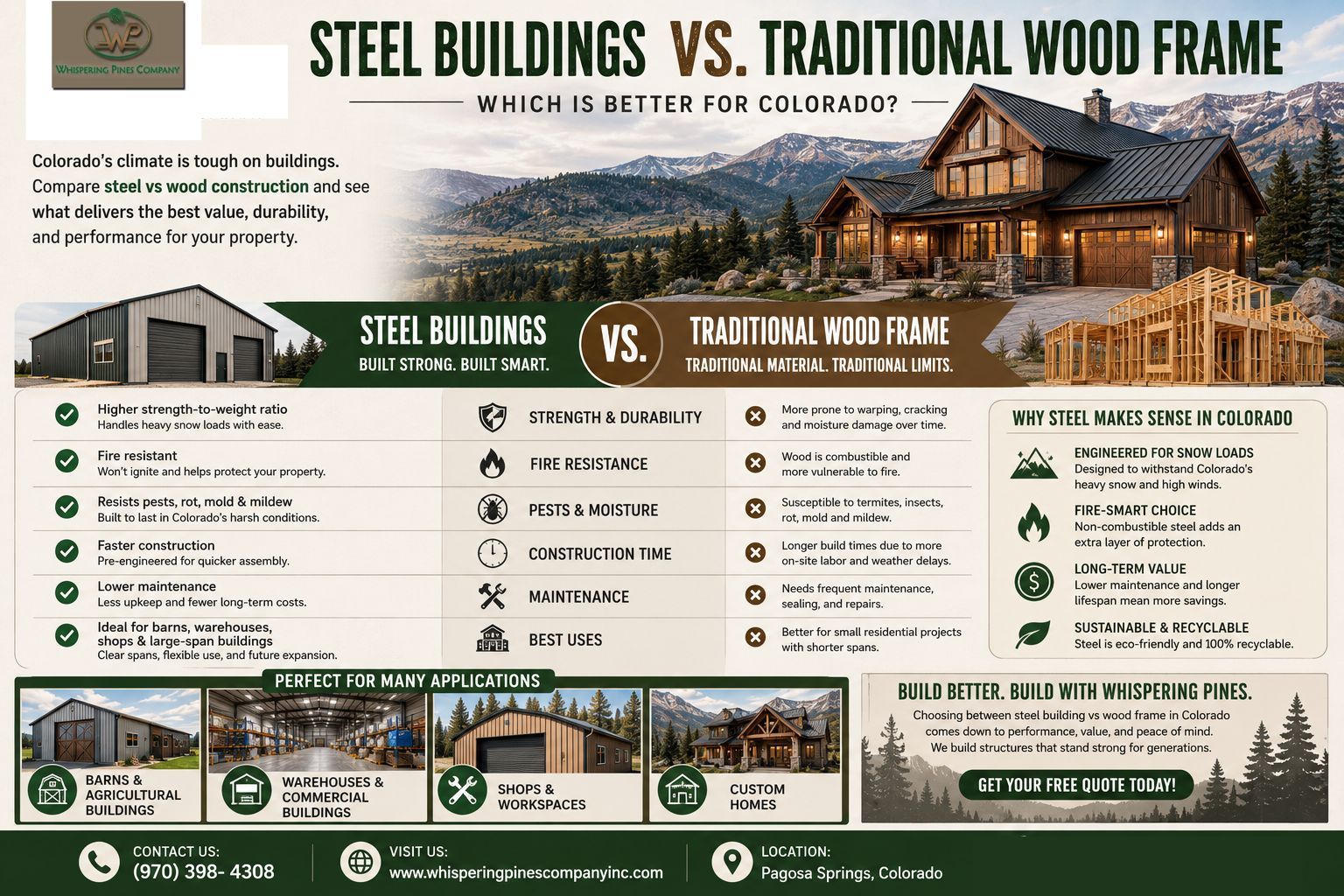
You've got land. Maybe it's a few acres outside Pagosa Springs with a mountain view that still makes you stop and stare every morning. Maybe it's a commercial lot in Durango or a rural spread somewhere along the edge of the San Juan National Forest. Either way, you're staring at a blank slate and asking the same question every Colorado property owner eventually asks: what do I actually build — and what do I build it with? The debate around steel building vs wood construction in Colorado isn't new, but it's one that deserves a real, honest look — not a generic answer copied from a national building guide written by someone who's never seen a Colorado winter. This is the Mountain West. The rules are different here. The snow loads, the wind exposure, the wildfire risk, the dramatic temperature swings between seasons — all of it changes the calculus. Whether you're planning a residential steel building, a workshop, a barn, an equipment storage facility, or a full commercial structure, the decision between steel and wood framing will affect your budget, your timeline, your maintenance costs, and how well your building holds up decades from now. Let's break it down — material by material, condition by condition — so you can walk away knowing which direction makes sense for your property, your goals… and your long-term investment. Understanding Steel Construction: What It Is and How It Works What Is a Pre-Engineered Steel Building? A pre-engineered steel building (PEB) is a system designed off-site using precise engineering calculations, then fabricated and assembled on-site. These structures are optimized for load-bearing efficiency, reducing material waste while improving strength. In the context of steel building vs wood construction in Colorado, PEBs provide predictable performance under snow and wind loads. Unlike wood, which can vary in density and moisture content, steel components are manufactured to exact specifications. This precision is why many property owners turn to a metal building contractor in Colorado for projects requiring structural reliability. Types of Steel Buildings: Rigid Frame, Clear Span, and Modular Steel buildings are not one-size-fits-all. Rigid frame systems offer maximum strength for industrial and commercial applications. Clear span designs eliminate interior columns, making them ideal for open layouts. Modular steel structures provide flexibility for phased construction. When evaluating steel building vs wood construction in Colorado, these variations matter. Steel allows customization without compromising structural integrity. A steel construction contractor in southwest Colorado can tailor the system to terrain, load requirements, and intended use. Common Uses: Workshops, Barns, Commercial Buildings, Agricultural Structures Steel buildings dominate in functional spaces where durability matters more than decorative detailing. Workshops, barns, and agricultural facilities benefit from steel’s resistance to pests, moisture, and structural fatigue. For example, a steel workshop or barn in Pagosa Springs must withstand heavy snow accumulation and temperature fluctuations. Steel ensures long-term usability without frequent repairs, making it a preferred option for durable buildings for Colorado weather . Steel vs. Wood: Head-to-Head Comparison for Colorado Conditions Durability and Weather Resistance (Snow, Wind, Hail) Colorado’s climate tests structural limits. Steel’s high tensile strength allows it to resist deformation under snow loads exceeding 60 psf. It also performs better against hail impact and high winds. In steel building vs wood construction in Colorado, wood may flex under pressure but can weaken over time due to moisture absorption. Steel maintains its integrity, reducing the risk of structural failure in extreme conditions. Wildfire Resistance — Critical in Southwest Colorado Wildfire risk has reshaped construction priorities. Steel is non-combustible, meaning it does not ignite or contribute to fire spread. Wood, even when treated, remains vulnerable to ember exposure. This makes residential steel buildings in Colorado increasingly attractive in fire-prone zones. Insurance providers often favor steel structures, reflecting lower risk profiles in steel buildings vs. wood construction in Colorado decisions. Construction Timeline and Speed Time matters, especially in regions with short building seasons. Steel structures benefit from prefabrication, reducing on-site construction time by up to 40%. Wood framing requires cutting, fitting, and adjustments on-site, which can delay projects. For clients prioritizing speed, steel building vs. wood construction in Colorado often leans toward steel due to efficiency and predictability. Long-Term Maintenance Requirements Maintenance is where the gap widens. Wood requires sealing, painting, and pest control every few years. Steel, with proper coatings, resists corrosion and requires minimal upkeep. For property owners seeking durable buildings for Colorado weather, steel significantly reduces long-term maintenance costs. This is a critical factor in any steel vs wood frame cost comparison . Upfront Cost vs. Lifetime Value Wood is typically cheaper upfront, making it appealing for budget-conscious builds. However, steel offers better lifecycle value due to lower maintenance and longer lifespan. In steel building vs wood construction in Colorado, the true cost emerges over decades. Steel’s durability offsets its initial investment, making it a strategic choice for long-term property ownership. When Steel Is the Better Choice in Colorado Large Clear-Span Spaces (Workshops, Garages, Equipment Storage) Steel excels in creating wide, open spaces without interior supports. This is essential for workshops, garages, and storage facilities. A steel workshop or barn in Pagosa Springs benefits from clear-span design, allowing flexible use of space. This advantage highlights why steel building vs wood construction in Colorado often favors steel for functional structures. Commercial and Agricultural Applications Commercial and agricultural buildings demand durability and efficiency. Steel meets both requirements while reducing operational downtime due to repairs. A steel construction contractor in southwest Colorado can design structures that support heavy equipment, livestock, and storage needs without compromising safety. Properties in High Fire Risk Zones In wildfire-prone areas, steel provides a critical layer of protection. Its non-combustible nature reduces structural loss during fire events. This makes residential steel building in Colorado a practical choice for properties located in high-risk zones, reinforcing the advantages seen in steel building vs wood construction in Colorado. Long-Term Investment in Durability Steel buildings are built for longevity. With proper maintenance, they can last 50+ years without significant structural degradation. For property owners focused on long-term value, steel building vs wood construction in Colorado clearly positions steel as a durable investment. When Wood Frame Construction Still Makes Sense Custom Residential Homes with Complex Architecture Wood allows intricate designs, curved elements, and traditional aesthetics that steel may not easily replicate. In steel building vs wood construction in Colorado, wood remains relevant for homeowners prioritizing architectural detail over structural longevity. Matching Existing Neighborhood Aesthetics In established neighborhoods, maintaining visual consistency can be important. Wood framing supports traditional designs that align with surrounding homes. However, hybrid approaches—steel frames with wood finishes—are becoming more common in residential steel building in Colorado projects. Smaller Accessory Structures For sheds or small cabins, wood may still be cost-effective due to lower material and labor requirements. Even in these cases, conducting a steel vs wood frame cost comparison ensures informed decision-making. Whispering Pines: Steel Construction Contractor Serving Pagosa Springs, Durango & Chama Our Steel Building Process from Design to Completion Whispering Pines begins with site evaluation, analyzing soil, slope, and environmental exposure. From there, they design structures optimized for steel building vs wood construction in Colorado conditions. Their collaboration with a metal building contractor in Colorado ensures precision from fabrication to installation. Residential, Agricultural, and Commercial Steel Projects Whispering Pines handles diverse projects, from homes to barns and commercial facilities. Their expertise in advantages of steel buildings in mountains allows them to deliver structures that perform under pressure. Whether it’s a steel workshop or barn in Pagosa Springs or a residential build, their approach prioritizes durability and efficiency. Request a Free Steel Building Quote Transparency defines their process. Clients receive detailed estimates, helping them evaluate steel vs wood frame cost comparison without hidden costs. This clarity ensures confidence when choosing between steel building vs wood construction in Colorado. Conclusion: The Right Material for Your Colorado Property The steel building vs wood construction in Colorado question doesn't have one answer that fits every property, every use case, or every budget. What it has is a set of real factors — climate, elevation, use, budget, timeline, and long-term ownership goals — that, when evaluated honestly, point toward the right choice for your specific situation. What's clear is this: in southwest Colorado, the structural demands are real. The snow loads are serious. The wildfire risk is growing. The temperature swings are significant. And the investment you're making in a building on Colorado land is substantial enough that it deserves to be thought through carefully — material choice and all. Steel offers durability, low maintenance, engineering precision, and wildfire resistance that is genuinely valuable in this environment. Wood frame offers flexibility, residential finish quality, and a construction ecosystem that's deeply established across the region. Both materials, built well by experienced contractors who understand southwest Colorado's specific demands, can produce buildings that serve you for decades. If you're planning a workshop, barn, agricultural structure, commercial building, or residential build in the Pagosa Springs, Durango, or Chama area, Whispering Pines Construction brings hands-on experience in both steel and wood frame work to every project. They know the county permit process, the snow load requirements, the soil conditions, and the construction logistics of southwest Colorado — because they've been working here, building here, and solving these exact problems here for years. The decision between steel and wood will become clear once you've had an honest conversation about your specific site, your goals, and your long-term vision. That's the conversation Whispering Pines is ready to have with you. Ready to Plan Your Colorado Build? Contact Whispering Pines for a Free Consultation Whether you're leaning toward a steel workshop, a wood frame custom home, a hybrid structure, or you're still not sure what direction makes the most sense, Whispering Pines Construction can help you figure it out. Serving Pagosa Springs, Durango, Chama, NM, and surrounding communities in southwest Colorado and northern New Mexico. Reach out today for a free consultation and get a clear-eyed, site-specific assessment of which construction approach fits your property, your goals, and your budget. No pressure. No generic answers. Just honest guidance from people who build in this region every day. FAQs About Steel Buildings in Colorado How much does a steel building cost in Colorado? Steel building costs in Colorado typically range from $15 to $40+ per square foot for the structure, depending on size, complexity, and local site conditions. Larger buildings generally have a lower cost per square foot. Contact Whispering Pines for a custom quote on your specific project in Pagosa Springs, Durango, or Chama. Are steel buildings good in snowy mountain climates like Pagosa Springs? Yes. Pre-engineered steel buildings are designed to specific snow load requirements and perform exceptionally well in heavy snowfall regions. Colorado's building codes require structures to meet local snow load minimums, and steel's high strength-to-weight ratio makes it an ideal choice for mountain environments. Can a steel building be used as a residential home? Absolutely. Steel-frame construction is increasingly popular for residential homes, offering fire resistance, pest resistance, and long-term durability. Whispering Pines builds both residential steel-frame structures and custom homes depending on the client's vision and site requirements. Q: Do steel buildings require more maintenance than wood buildings? Generally, steel buildings require less maintenance over time. Steel doesn't warp, rot, or get damaged by pests, and modern coatings protect against rust and UV damage. This makes steel an excellent long-term investment for Colorado property owners.